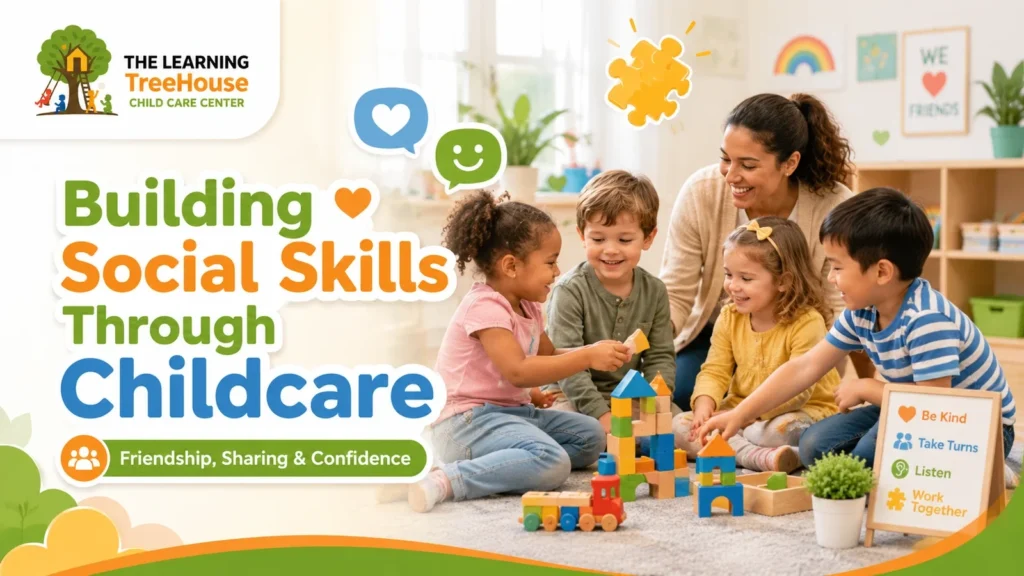
Social skills are an important part of early childhood development. Children are not born knowing how to share, take turns, solve problems, use kind words, or express feelings clearly. These skills are learned through practice, guidance, repetition, and positive interaction with others.
For many children, a childcare center is one of the first places where they spend regular time with other children outside the home. This gives them daily opportunities to communicate, play, cooperate, listen, wait, help, and build friendships.
At The Learning Treehouse in Pasadena, TX, children are supported through play, group activities, daily routines, and caring teacher guidance. Our goal is to help children grow socially, emotionally, and confidently in a warm childcare environment.
Families who want to learn more about our care options can also explore our childcare programs in Pasadena, TX.
Why Social Skills Matter in Early Childhood
Social skills help children understand how to interact with others. These skills affect how children make friends, join group activities, ask for help, express feelings, solve small problems, and adjust to school settings.
When children develop social skills early, they often feel more confident around teachers and other children. They begin to understand classroom expectations, group routines, personal space, sharing, listening, and cooperation.
Strong social skills can support:
- Communication
- Confidence
- Friendship building
- Emotional regulation
- Problem-solving
- Patience
- School readiness
- Kindness and empathy
- Positive behavior
Social development is not something children learn in one day. It grows through many small experiences over time.
Childcare Gives Children Daily Practice With Others
One of the biggest benefits of childcare is consistency. Children are not only around other children once in a while. They interact with classmates and teachers every day.
These daily moments create natural opportunities to practice social skills. Children may learn to wait for a toy, ask a friend to play, clean up together, listen during storytime, follow a group routine, or take turns during an activity.
In a childcare center, social learning happens during playtime, meals, art, music, outdoor play, circle time, storytime, and classroom transitions.
Our classroom environment supports children with structure, comfort, routines, and age-appropriate learning experiences.
Learning to Share and Take Turns
Sharing can be difficult for young children. Toddlers and preschoolers are still learning that other children have feelings, needs, and ideas too.
A childcare center gives children repeated chances to practice sharing in a guided way. Teachers can gently help children understand phrases like:
- “Your turn is next.”
- “Let’s use kind hands.”
- “Can we share this together?”
- “You can have a turn when your friend is finished.”
Over time, children begin to understand patience, fairness, and cooperation.
Sharing does not mean a child will always give something up immediately. It means they are slowly learning how to participate with others, respect turns, and handle waiting.
Building Communication Skills
Children build communication skills by talking with teachers and other children throughout the day. They learn how to ask for help, answer questions, express needs, describe feelings, and use words instead of frustration.
Group activities, storytime, songs, pretend play, and classroom conversations all help children practice language in a natural way.
For example, a child may learn to say:
- “Can I play?”
- “I need help.”
- “It is my turn.”
- “I feel sad.”
- “Can we build together?”
These simple phrases are powerful because they help children connect with others and express themselves more clearly.
Our toddler and preschool program supports children with language development, social growth, routines, and play-based learning.
Learning How to Handle Feelings
Young children experience big emotions. They may feel excited, frustrated, tired, shy, angry, nervous, or disappointed. A childcare center can help children learn how to recognize and manage these feelings in a safe setting.
Teachers can support children by naming emotions and offering calm guidance. For example:
- “I see you are upset.”
- “Let’s take a deep breath.”
- “Can you tell me what happened?”
- “You wanted a turn, and waiting felt hard.”
This helps children feel understood. It also teaches them that feelings are normal and can be handled with words, comfort, and support.
Over time, children begin to understand their own emotions and the feelings of others. This is an important step toward empathy and self-control.
Making Friends Through Play
Friendships often begin during play. Children may build towers together, pretend to cook food, draw pictures, run outside, play games, or create stories with toys.
Through play, children learn teamwork, kindness, patience, imagination, and problem-solving. They also learn how to join a group, invite others, listen to ideas, and handle small disagreements.
Play gives children a safe way to practice real-life social situations. A child may learn how to say, “Do you want to play with me?” or “Let’s build this together.”
Our indoor play area and outdoor play area give children opportunities to move, create, explore, and build friendships in supervised spaces.
Group Routines Teach Cooperation
Daily routines help children understand how to be part of a group. In childcare, children practice sitting together, listening to teachers, washing hands, lining up, cleaning up, eating meals, resting, and moving from one activity to another.
These routines teach children that everyone has a role in the classroom community.
A child may learn to wait while others wash hands, help put toys away, sit with friends during meals, or listen while another child is speaking. These small daily habits build cooperation and respect.
Our teaching environment supports children through routines, guidance, hands-on learning, and teacher-led activities.
Pretend Play Builds Empathy and Imagination
Pretend play is more than fun. It helps children understand people, roles, feelings, and everyday situations.
When children pretend to be teachers, parents, doctors, cooks, cashiers, or helpers, they are practicing communication and empathy. They may copy kind words they have heard from adults or act out familiar routines from home and school.
Pretend play also helps children learn how to negotiate. One child may say, “I will be the doctor,” while another says, “I want to be the patient.” With guidance, they learn how to take roles, listen, and cooperate.
This kind of play supports language, imagination, confidence, and social understanding.
Teachers Help Guide Positive Behavior
Children do not always know how to solve problems on their own. They may grab a toy, cry, yell, push, or walk away when they feel upset.
A caring teacher can turn these moments into learning opportunities. Instead of only correcting behavior, teachers can help children understand what happened and what they can do next time.
For example, a teacher may say:
- “Use gentle hands.”
- “Tell your friend, ‘I am using this.’”
- “Let’s ask for a turn.”
- “We can solve this together.”
This kind of guidance helps children build better habits over time.
In a strong childcare environment, discipline should be about teaching, not shaming. Children need patient reminders, clear expectations, and caring adults who help them learn.
Social Skills Support School Readiness
Social skills are closely connected to school readiness. Before children enter kindergarten, they benefit from learning how to listen, follow directions, wait their turn, communicate needs, participate in group activities, and work with others.
These skills help children adjust more easily to classroom expectations.
Academic learning matters, but children also need confidence, independence, emotional control, and communication skills. A child who can ask for help, listen during group time, and play kindly with others is better prepared for future learning.
Our Early Pre-Kindergarten Program and Pre-Kindergarten Program help children build early learning, confidence, classroom routines, and school readiness skills.
How Parents Can Support Social Skills at Home
Parents can support social development with simple daily habits at home.
You can encourage your child to use kind words, take turns during games, help clean up, talk about feelings, share during family activities, and practice simple problem-solving.
You can also read books about friendship, feelings, kindness, and cooperation. After reading, ask questions like:
- “How did the character feel?”
- “What could they do next?”
- “Was that a kind choice?”
- “What would you say to a friend?”
These conversations help children connect stories to real-life situations.
Why a Safe Environment Helps Social Growth
Children are more likely to interact, explore, and make friends when they feel safe. A child who feels anxious or unsupported may struggle to participate.
A safe childcare environment gives children the confidence to try new activities, speak with teachers, join classmates, and build friendships.
Clean spaces, steady routines, caring teachers, and supervised play all help children feel secure. Our safe and clean environment is designed to support children’s comfort, confidence, and well-being.
Final Thoughts
Social skills are built through practice, patience, and positive guidance. A childcare center gives children a safe place to learn how to communicate, share, take turns, make friends, manage emotions, and participate in group routines.
These skills support confidence, kindness, school readiness, and emotional growth.
For families in Pasadena, TX, The Learning Treehouse provides a warm childcare environment where children can learn, play, build friendships, and grow socially and emotionally.
Call (713) 485-4004 or schedule a tour today to learn more about our childcare programs.
Childcare and Social Skills FAQs
How does a childcare center help children build social skills?
A childcare center gives children daily opportunities to share, communicate, play with others, follow routines, solve small problems, and build friendships with teacher guidance.
What social skills should young children learn?
Young children benefit from learning how to share, take turns, listen, use kind words, ask for help, express feelings, follow routines, and play cooperatively.
Why is play important for social development?
Play helps children practice communication, teamwork, imagination, patience, kindness, problem-solving, and friendship-building in a natural way.
How do teachers help children handle conflicts?
Teachers can help children name feelings, use words, take turns, listen to others, and find simple solutions instead of grabbing, yelling, or pushing.
Do social skills help with school readiness?
Yes. Social skills help children listen, follow directions, join group activities, ask for help, wait their turn, and feel more confident in classroom settings.
How can parents help children build social skills at home?
Parents can practice turn-taking, read books about feelings, encourage kind words, talk about emotions, play simple games, and model respectful communication.
Are social skills important for toddlers and preschoolers?
Yes. Toddlers and preschoolers are at an important stage for learning communication, sharing, emotional expression, friendship, and group routines.
How can I learn more about The Learning Treehouse?
Parents can call (713) 485-4004 or schedule a tour to learn more about childcare programs at The Learning Treehouse in Pasadena, TX.